The evolution of Homo sapiens has made the transition into the orthostatic vertical position, which is a huge evolutionary step that allowed the release of human upper limb for hunting, working, creativity... Due to biped locomotion and sedentary way of life, evolves the degenerative pathologies of the spine. According to the U.S. National Center for Health Statistics, 2005, 26-32% of the population aged up to 45 years old, suffers and is limited in activities from permanent pain in cervical and lumbar regions of the spine. Degenerative-dystrophic pathology of the spine is a current topic in contemporary medicine.
History of medicine, back pain treatment, are going in
depths of millennia, first mentions appearing in the Edwin Smith
Surgical Papyrus dated 1550-1500 years BC. Manuscript which
describes traumatology, treatment in spinal disorders, applied in
ancient Egypt during the reign of Pharaoh and amazes us with deep
knowledge in human anatomy.
There is no one who has not ever suffered from back pain. According to radiological investigation, the degenerative-dystrophic pathology of the spine - osteochondrosis, is an ageing process of the spine, the result of disc involution.
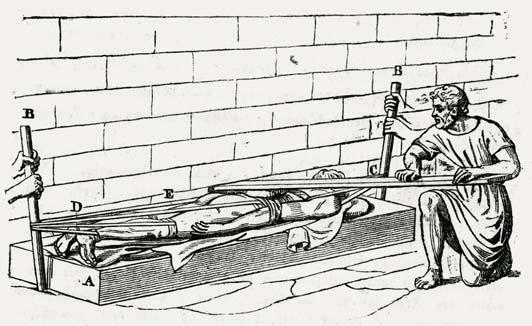
Spine extension method is being used since antiquity, which was described by Hippocrates 460-370 BC. Hippocrates traction table is known as being used in the treatment of spinal deformities and pathologies.
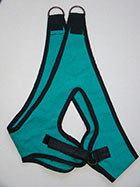 Francis Glisson (1597 -
1677) british physician, physiologist and anatomist has published
in 1650 De Rachitide study , where he described the pathological
changes in rickets and its etiology. Glisson has developed the
treatment in spine deformity, based on gymnastics and invented the
loop(harness) for cervical spine extension, using it to treat
scoliosis, which was later called Glisson loop, used until
nowadays in cervical spine extension procedures. Medicine has
evolved over millennia, there have been many new discoveries,
inventions, new methods of treatment, but some of them haven't
lost their timeliness up today, being tested throughout the ages.
Some of them refer to the spine extension.
Francis Glisson (1597 -
1677) british physician, physiologist and anatomist has published
in 1650 De Rachitide study , where he described the pathological
changes in rickets and its etiology. Glisson has developed the
treatment in spine deformity, based on gymnastics and invented the
loop(harness) for cervical spine extension, using it to treat
scoliosis, which was later called Glisson loop, used until
nowadays in cervical spine extension procedures. Medicine has
evolved over millennia, there have been many new discoveries,
inventions, new methods of treatment, but some of them haven't
lost their timeliness up today, being tested throughout the ages.
Some of them refer to the spine extension.
The extension mechanism of the intervertebral disc
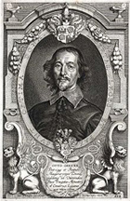 Otto von Guericke, German scientist, inventor, and politician.
One of his main scientific achievements was the creation of the physics of vacuums.
The famous experiment took place in 1654 in the city of Magdeburg, where he
demonstrated the presence of the vacuum and air pressure power. He took two
hemispheres made from copper with a diameter of 35.5cm and connected them
together forming an integrating sphere from which he pumped the air using a pump,
invented and manufactured by himself. 16 horses, each side by 8 could
not separate hemispheres. Later these hemispheres were known as the Magdeburg
hemispheres, and this experiment was repeated in 1663 in Berlin involving 24 horses.
Original hemispheres are currently kept in Deutsch Museum in München.
Otto von Guericke, German scientist, inventor, and politician.
One of his main scientific achievements was the creation of the physics of vacuums.
The famous experiment took place in 1654 in the city of Magdeburg, where he
demonstrated the presence of the vacuum and air pressure power. He took two
hemispheres made from copper with a diameter of 35.5cm and connected them
together forming an integrating sphere from which he pumped the air using a pump,
invented and manufactured by himself. 16 horses, each side by 8 could
not separate hemispheres. Later these hemispheres were known as the Magdeburg
hemispheres, and this experiment was repeated in 1663 in Berlin involving 24 horses.
Original hemispheres are currently kept in Deutsch Museum in München.

In such a way physical forces have an impact on the intervertebral disc through spine extension:

Spine extension lowers the pressure between discs in the spinal disk segment, normalizes the ratio between the facet joints, intervertebral space increases, and induce artery decompression, spinal nerve rootlets in the region of the intervertebral holes. Because of the ”vacuum effect” there is a centring of the nucleus pulpous, and exists the possibility of return or withdrawal of the herniated content from nucleus pulpous, which is helped by posterior longitudinal ligament tension during extension(in case of medial hernias).
